Build the software your competitors can't buy
We work with your team to find the opportunities and bottlenecks that matter most, map how the work really happens and build the software to act on them. Customer-facing or internal, governed by default and yours to own.



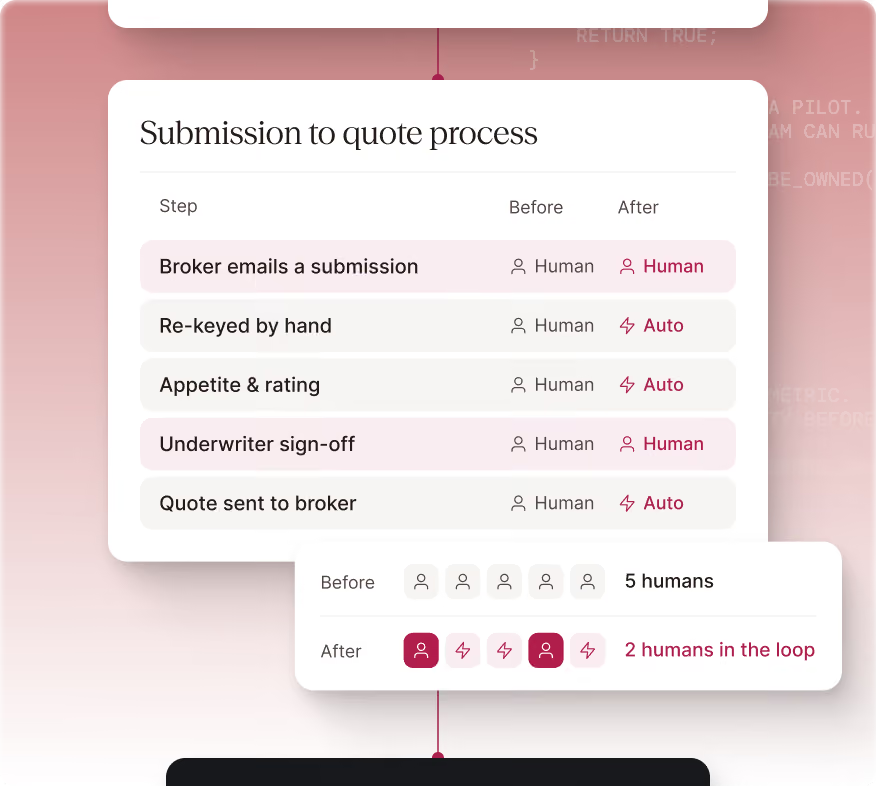
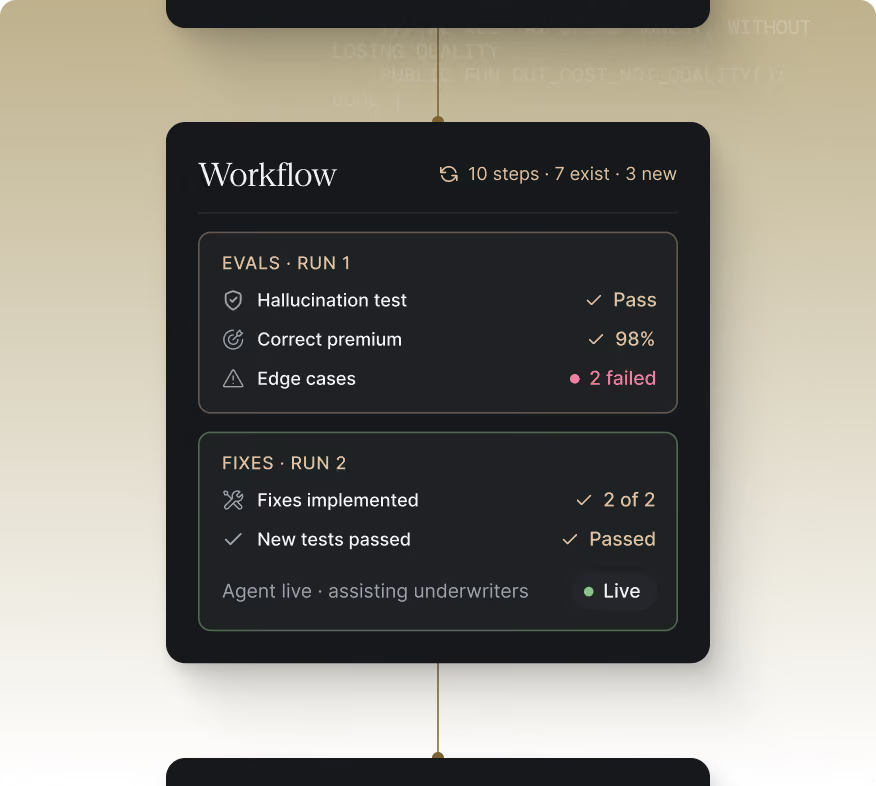
Maria needs to quote faster than her competitors.
Maria runs commercial underwriting at a mid-sized insurer. Brokers email submissions, her team re-keys them into a rating spreadsheet, and quotes take days. Brokers place the business with whoever answers first.
Interviewer talks with Maria's underwriters and the team that works with brokers. The same story keeps coming up: every submission is re-keyed by hand, and the best risks go to faster carriers.
TraceWorks maps submission to quote from the interviews, broker emails, the rating spreadsheet and policy-system exports, including where submissions stall.
The map becomes a PRD of ten user stories.
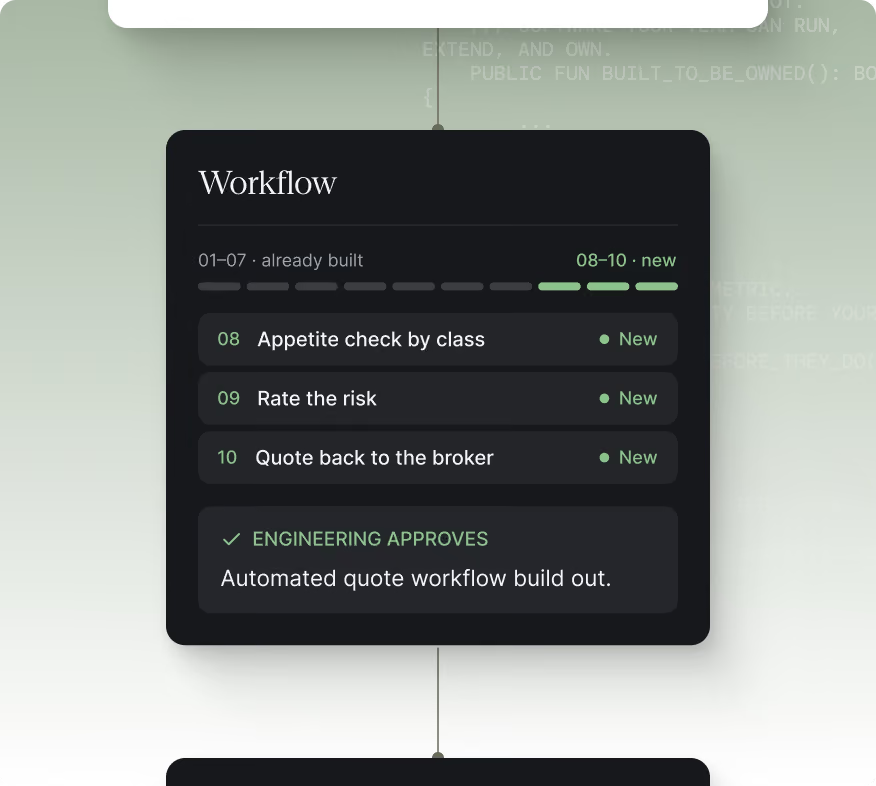
Seven are already built in other apps, including document intake, approvals, the audit trail and the policy-system connector. They're reused.
Three are new: the appetite check, the rating logic and the broker quote portal. The build agent writes them, and engineering approves.
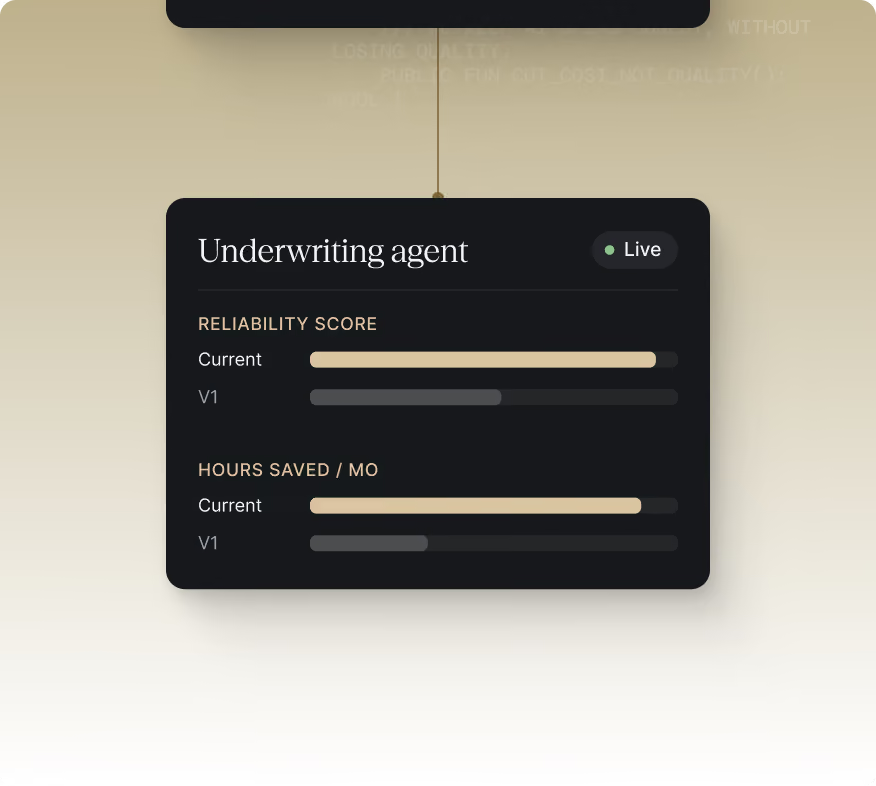
Brokers get quotes the same day, through a portal they use directly. The new logic is ready for the next line of business.
Where good ideas get stuck

Every team has problems it wants solved. Few have evidence for which ones are worth building software for.
The roadmap is full of products and workflows your team can't get to.

What teams build on their own has no shared identity, data access or audit trail.
What's inside the factory
Seven parts, from the first interview to the production release. Each one is already built, so your team starts with the problem, not the plumbing.
Interviewer
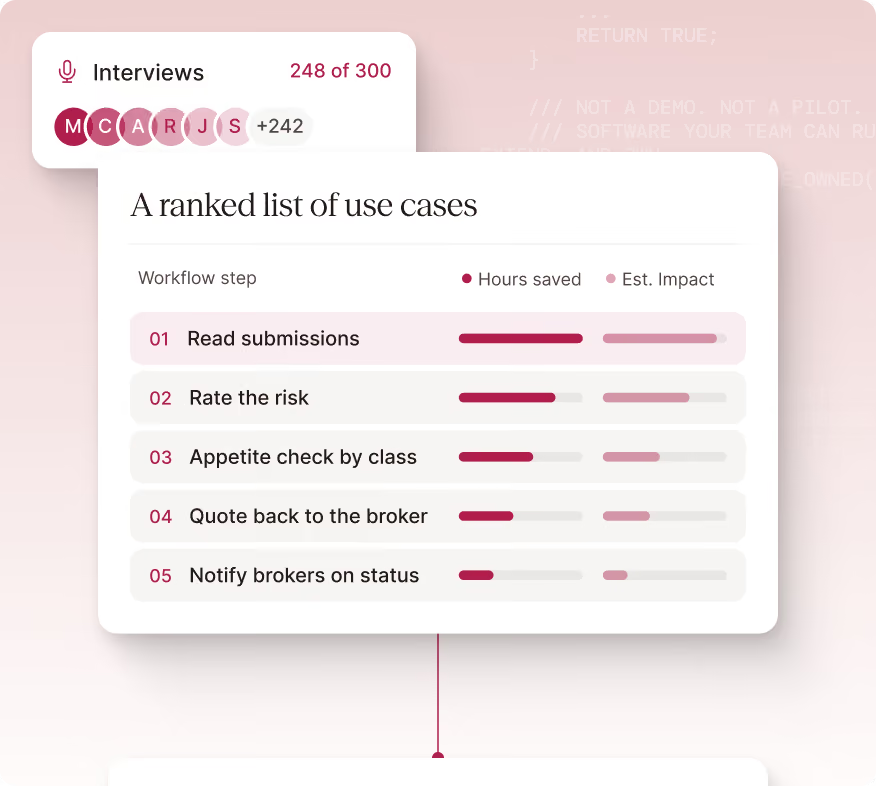
Interviewer talks with hundreds of people at once about how they actually work, then ranks the opportunities by business impact, from hours saved to revenue gained.
- Interviews at scale
One team or the whole company, in days. - Role-based questions
Each person is asked about their own work, in their own terms. - A ranked list of use cases
Pain points grouped and scored across teams, not taken from one loud voice.
TraceWorks
TraceWorks combines interviews, documents, system exports and screenshots into one process model of roles, systems, controls, handoffs and exceptions.
- Evidence for every claim
Each step points back to its source. Anything unconfirmed is marked as a gap, not stated as fact. - Systems and controls mapped
The applications, data and controls each process depends on. - Requirements, not slides
The map becomes the requirements and PRD the build starts from.
Product lifecycle
The PRD becomes user stories, matched against what's already built. Build agents write only what's new, and engineering approves every release.
- Stories from the map
Each user story traces back to the process it changes. - Reuse before build
Stories already built in other apps are reused, not rewritten. - Engineering approves
Nothing ships without your team's sign-off.
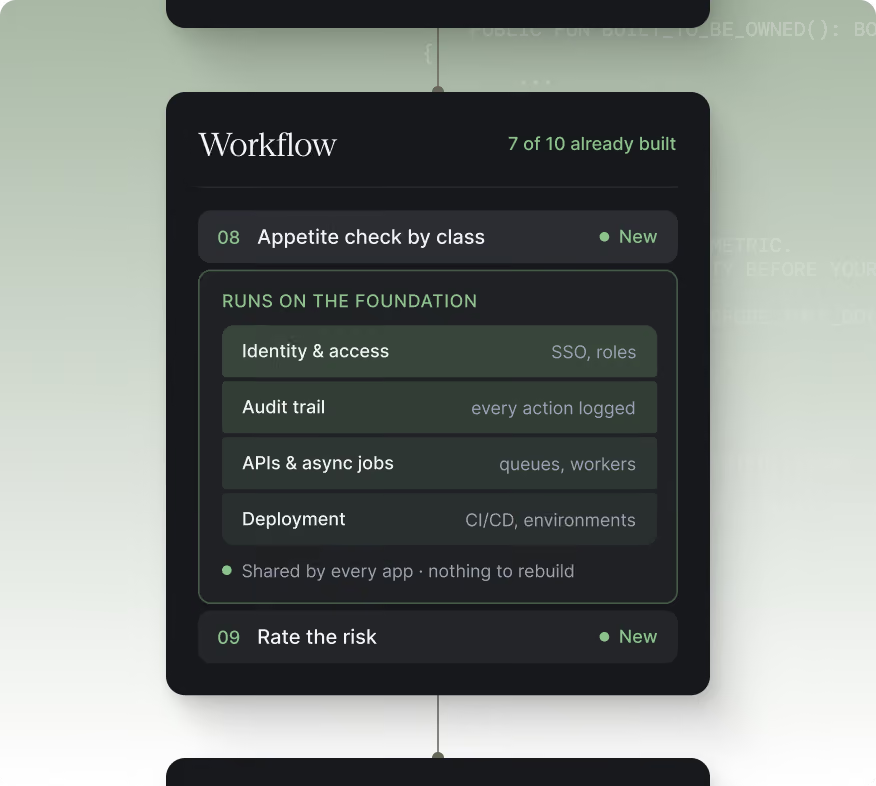
Pre-engineered foundation
Identity, data, APIs, async processing and deployment are settled once, so no team rebuilds them for the next app.
- Identity and access
SSO, roles and permissions shared by every app. - Audit trail
Every action logged, in every app, from day one. - Deployment
CI/CD pipelines and environments ready before the first build.
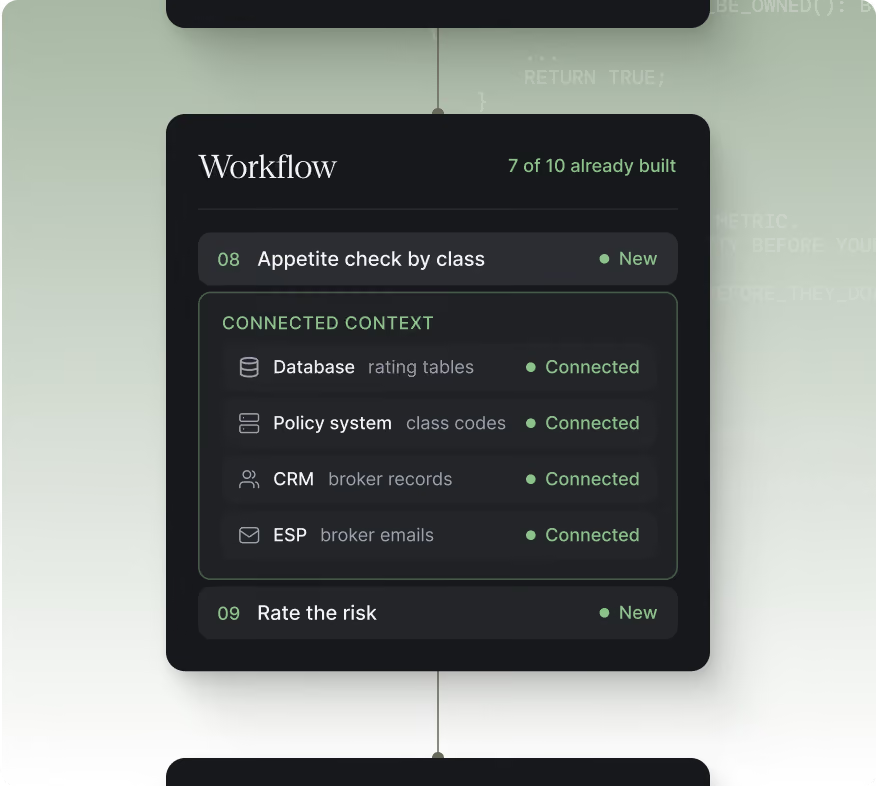
Context layer
Connect your warehouse, documents, ERP and SaaS tools once. Every app and agent uses the same business definitions under the same permissions.
- Reuse enterprise meaning
Definitions, catalog metadata and relationships, built once. - Govern access at the boundary
Identity, permissions and query controls on every API and MCP tool. - Improve with your experts
Corrections are reviewed before new context reaches any app.
Evals
Traces, user feedback and curated evals tie every output to the outcome it should deliver.
- Feedback from real work
Corrections captured where users see the output, linked to the run. - Tests for uncertain outputs
Representative eval sets and grading criteria, alongside software tests. - Evidence for every release
Decide what to improve, hold or ship.
Model optimization and routing
Grade models on representative work, pin what's proven and route only where the evidence shows a gain.
- Set the bar first
Score candidate models on your work, then compare cost and speed. - Pin what's proven
Known tasks run on a pinned model, reviewed as evals change. - Route where it pays
Variable work goes to the cheapest model that clears the bar, with bounded escalation.
From interview to production
We use Interviewer and TraceWorks to find what matters before anything is built.
Each app starts on what's already built, on the cheapest model that meets the bar.
One identity, audit trail and set of evals across every app.
In your cloud. Your code, your IP, no platform licence.

Before the build, Interviewer ran role-based interviews across the organization. The factory then delivered a regulated-content review app that checks claims against source material and keeps an evidence trail. The context layer let the team skip a data lake project already over a year in.
Interviewer ran with the technical-response teams before the build. The factory delivered triage, runbook matching and reviewer-approved actions, with AI spend tied to cost per useful outcome.
Questions leaders ask us
You do. The code and the IP are yours from day one, with no platform licence.
No. Interviewer and TraceWorks find and map the problems worth solving first. If you already know, we start there.
No. We use AI where it makes the software better, such as reading documents, classifying requests or drafting responses. Where rules and plain software do the job, that's what we build.
They could. Deploying ours means discovery, the foundation, context, evals and routing are already built, so your first app goes live as part of the deployment. You still own all of it.
The people you choose: one team, a function or the whole company. Each person gets questions about their own role.
In your cloud, under your security controls. Your systems of record stay where they are.
Why each app was built, who requested it, what was built, how it was evaluated and who approved the release. Every step traces back to evidence and an identity.
Yes, inside the same guardrails. Business teams request and shape apps, and engineering approves what ships.
No. Application Factory is for new software. For the codebases you already run, AI SDLC makes your teams faster with no migration.
Start with the problems that matter most
We start by finding and mapping your highest-impact opportunities and bottlenecks with Interviewer and TraceWorks. Then we deploy the factory in your cloud and build the first applications with your team. Your team owns all of it, with everything it needs to run and extend it.